I produced a 5 minute video about using advanced search on Emerald Insight (journal article collection which is strong in information and management/ marketing topics). The Emerald collection is at http://www.emeraldinsight.com/ (log into MUSE before searching)
Showing posts with label Gather. Show all posts
Showing posts with label Gather. Show all posts
26 November 2013

19 November 2013
Another excellent powerpoint from Karen Blakeman
This focuses on alternatives to Google, and as usual is very up to date and useful
Searching tips from class members, on team blogs
These are links to blog entries in which class members identify what search tips they would give, or found most useful.
A Team: Group A http://informationgroupa.blogspot.co.uk/2013/10/more-google-database-search-tips.html and http://informationgroupa.blogspot.co.uk/2013/10/google-database-search-tips.html
B Team: Simple http://simplealamanda.blogspot.co.uk/2013/10/database-search-tips.html and http://simplealamanda.blogspot.co.uk/2013/10/database-search-tip.html
C Team: JATA :) http://inf6350teamc.blogspot.co.uk/2013/10/database-or-google-search-tip.html
D: TEAM D http://6350teamd.blogspot.co.uk/2013/10/search-tip.html and http://6350teamd.blogspot.co.uk/2013/10/google-search-tip-linxi.html and http://6350teamd.blogspot.co.uk/2013/10/jan-google-search-tip.html
E : Team E for INF6350 http://inf6350team.blogspot.co.uk/2013/10/matta-database-searching-tips.html and http://inf6350team.blogspot.co.uk/2013/10/searching-tips.html
F: Team F6350 http://teamf6350.blogspot.co.uk/2013/10/database-or-google-search-tips.html
G: Team G Blog http://teamginfoliteracy2013.blogspot.co.uk/2013/10/top-tip-for-database-searching.html
H: Hey ischool! http://ihteam.blogspot.co.uk/2013/10/database-or-google-search-tip.html and http://ihteam.blogspot.co.uk/2013/10/broaden-academic-searching-field.html and http://ihteam.blogspot.co.uk/2013/11/the-essential-information-searching.html
I: Group I INF6350 blog http://inf6350-groupi.blogspot.co.uk/2013/10/yiwens-google-search-tips.html
J Team: Team J http://teamj123.blogspot.co.uk/2013/10/using-google-scholar-in-study-of.html
K: Team K's blog http://teamkinfolit.blogspot.co.uk/2013/10/search-databases-tip.html and http://teamkinfolit.blogspot.co.uk/2013/10/search-tip-shuai-first-is-to-find-rover.html and http://teamkinfolit.blogspot.co.uk/2013/10/search-tip.html
L Team: Team L http://jzhang35.blogspot.co.uk/2013/10/google-database-search-session-tips.html
M Team: The Literate Librarian http://litlib.blogspot.co.uk/2013/10/information-via-web-and-databases.html and http://litlib.blogspot.co.uk/2013/10/googledatabase-searching-sessions.html and http://litlib.blogspot.co.uk/2013/10/know-much-about-google.html and http://litlib.blogspot.co.uk/2013/10/utilising-more-of-google-and-databases.html
N: Team N !! http://group2teamn.blogspot.co.uk/2013/10/new-finding-about-google.html
O Team: We Are 'O' So Good! http://weareosogood.blogspot.co.uk/2013/10/database-search-tip.html
Q: Team Q's INF6350 Blog http://teamqinf6350.blogspot.co.uk/2013/10/search-tips.html and http://teamqinf6350.blogspot.co.uk/2013/10/emily-top-tips-for-searching.html and http://teamqinf6350.blogspot.co.uk/2013/10/chloes-search-tip.html
R: Team R - Group Blog 2013 http://teamrinfolit.blogspot.co.uk/2013/11/double-trouble-my-information-needs-and.html
U: INF6350teamU http://inf6350teamu13.blogspot.co.uk/2013/10/my-best-searching-tip.html
V Team: First Day http://firstdayinfolit.blogspot.co.uk/2013/10/jaynes-searching-tips.html
W: Team W http://teamnorthw.blogspot.co.uk/2013/10/tips-for-google-and-database-search.html
A Team: Group A http://informationgroupa.blogspot.co.uk/2013/10/more-google-database-search-tips.html and http://informationgroupa.blogspot.co.uk/2013/10/google-database-search-tips.html
B Team: Simple http://simplealamanda.blogspot.co.uk/2013/10/database-search-tips.html and http://simplealamanda.blogspot.co.uk/2013/10/database-search-tip.html
C Team: JATA :) http://inf6350teamc.blogspot.co.uk/2013/10/database-or-google-search-tip.html
D: TEAM D http://6350teamd.blogspot.co.uk/2013/10/search-tip.html and http://6350teamd.blogspot.co.uk/2013/10/google-search-tip-linxi.html and http://6350teamd.blogspot.co.uk/2013/10/jan-google-search-tip.html
E : Team E for INF6350 http://inf6350team.blogspot.co.uk/2013/10/matta-database-searching-tips.html and http://inf6350team.blogspot.co.uk/2013/10/searching-tips.html
F: Team F6350 http://teamf6350.blogspot.co.uk/2013/10/database-or-google-search-tips.html
G: Team G Blog http://teamginfoliteracy2013.blogspot.co.uk/2013/10/top-tip-for-database-searching.html
H: Hey ischool! http://ihteam.blogspot.co.uk/2013/10/database-or-google-search-tip.html and http://ihteam.blogspot.co.uk/2013/10/broaden-academic-searching-field.html and http://ihteam.blogspot.co.uk/2013/11/the-essential-information-searching.html
I: Group I INF6350 blog http://inf6350-groupi.blogspot.co.uk/2013/10/yiwens-google-search-tips.html
J Team: Team J http://teamj123.blogspot.co.uk/2013/10/using-google-scholar-in-study-of.html
K: Team K's blog http://teamkinfolit.blogspot.co.uk/2013/10/search-databases-tip.html and http://teamkinfolit.blogspot.co.uk/2013/10/search-tip-shuai-first-is-to-find-rover.html and http://teamkinfolit.blogspot.co.uk/2013/10/search-tip.html
L Team: Team L http://jzhang35.blogspot.co.uk/2013/10/google-database-search-session-tips.html
M Team: The Literate Librarian http://litlib.blogspot.co.uk/2013/10/information-via-web-and-databases.html and http://litlib.blogspot.co.uk/2013/10/googledatabase-searching-sessions.html and http://litlib.blogspot.co.uk/2013/10/know-much-about-google.html and http://litlib.blogspot.co.uk/2013/10/utilising-more-of-google-and-databases.html
N: Team N !! http://group2teamn.blogspot.co.uk/2013/10/new-finding-about-google.html
O Team: We Are 'O' So Good! http://weareosogood.blogspot.co.uk/2013/10/database-search-tip.html
Q: Team Q's INF6350 Blog http://teamqinf6350.blogspot.co.uk/2013/10/search-tips.html and http://teamqinf6350.blogspot.co.uk/2013/10/emily-top-tips-for-searching.html and http://teamqinf6350.blogspot.co.uk/2013/10/chloes-search-tip.html
R: Team R - Group Blog 2013 http://teamrinfolit.blogspot.co.uk/2013/11/double-trouble-my-information-needs-and.html
U: INF6350teamU http://inf6350teamu13.blogspot.co.uk/2013/10/my-best-searching-tip.html
V Team: First Day http://firstdayinfolit.blogspot.co.uk/2013/10/jaynes-searching-tips.html
W: Team W http://teamnorthw.blogspot.co.uk/2013/10/tips-for-google-and-database-search.html
4 November 2013
Wise use of Wikipedia: an introduction
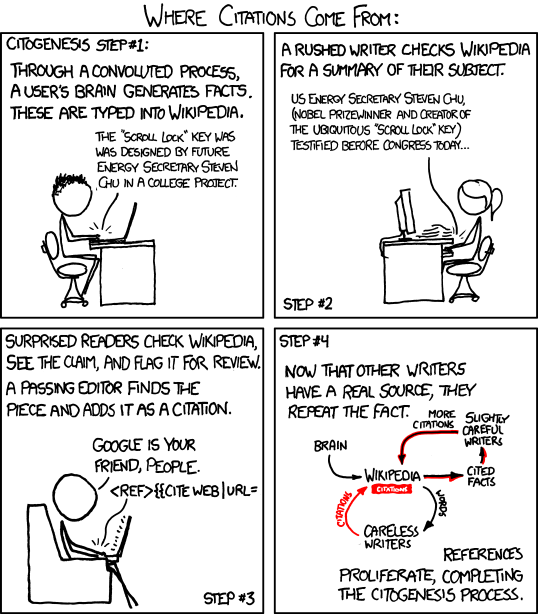
Many people have used Wikipedia, or equivalents in other countries. Also, many people have heard warnings about the quality of Wikipedia entries. You will be discussing an article about Wikipedia in week 7, in smaller seminar groups. This cartoon illustrates one problem that can occur (though obviously this problem of someone publishing an unchecked (untrue) "fact" in a reputable publication does not only happen with Wikipedia!

One thing you can do is to find out more about how Wikipedia works, and use all the parts of a Wikipedia page: not just the entry itself but the "View History" tab to see what changes have been made (you can also look at previous versions of the entry) and the "Talk" tab.
This is the "About" page on Wikipedia: from here you can find out a lot about how it is compiled and edited: http://en.wikipedia.org/wiki/Wikipedia:About
For those of you really interested in this topic, there is an interesting ethnographic study of Wikipedia editors:
Sundin, O. (2011). Janitors of knowledge: constructing knowledge in the everyday life of Wikipedia editors. Journal of Documentation, 67(5), 840-862. http://www.emeraldinsight.com/journals.htm?articleid=1949863
This is the open access preprint version http://lup.lub.lu.se/luur/download?func=downloadFile&recordOId=1693489&fileOId=2277516
One thing you can do is to find out more about how Wikipedia works, and use all the parts of a Wikipedia page: not just the entry itself but the "View History" tab to see what changes have been made (you can also look at previous versions of the entry) and the "Talk" tab.
This is the "About" page on Wikipedia: from here you can find out a lot about how it is compiled and edited: http://en.wikipedia.org/wiki/Wikipedia:About
For those of you really interested in this topic, there is an interesting ethnographic study of Wikipedia editors:
Sundin, O. (2011). Janitors of knowledge: constructing knowledge in the everyday life of Wikipedia editors. Journal of Documentation, 67(5), 840-862. http://www.emeraldinsight.com/journals.htm?articleid=1949863
This is the open access preprint version http://lup.lub.lu.se/luur/download?func=downloadFile&recordOId=1693489&fileOId=2277516
3 November 2013
Monitoring 2: Adding feeds to blogger
There are some features on Blogger itself that can be used for monitoring, so you could use these for your team blog. I made this video in 2011 showing two ways to add a feed from another blog onto your team blog. Once you have done this, links to the latest posts on your chosen blog appear on your blog. I’m afraid at the moment I’m not able to make a revised video, but the only changes since then are to do with how you find the page for editing the blog layout. Now (instead of clicking a tab at the top) you click on Layout, which is on the menu on the left hand side of the page.
In this video I firstly demonstrate adding an RSS feed from another blog, so that the latest few posts from that blog dispay on your blog, and then I demonstrate a way of adding a list of blog links.
If you look on this blog: I have used the first technique to add a feed of new articles from the Journal of Documentation (at the bottom of this page) and the second technique to add a list of the team blogs (on the right)
In this video I firstly demonstrate adding an RSS feed from another blog, so that the latest few posts from that blog dispay on your blog, and then I demonstrate a way of adding a list of blog links.
If you look on this blog: I have used the first technique to add a feed of new articles from the Journal of Documentation (at the bottom of this page) and the second technique to add a list of the team blogs (on the right)
Web 2.0 (and Netvibes)
This is the Netvibes page in which I have linked a number of resources about Web 2.0
http://www.netvibes.com/sheilawebber#Web_2.0_in_general
Go there to find out what Web 2.0 is, or look at the introductory powerpoint (on MOLE from Monday 4th) http://www.netvibes.com/sheilawebber#Web_2.0_in_general
If you are interested in using Netvibes yourself as a page for gathering links and feeds (which we won't cover in class) you might be interested in the presentation: Using Netvibes as a home page, by Phil Bradley:
20 October 2013
Please post your database or Google search tip!

What you need to do
Once you have had the 2nd session from the Alastair make an individual post on your team blog, listing one new thing you learnt about Google or database searching.
A few of you have had a lot of experience in libraries before joining the course: so if you were already a search engine/ database wizard when you came to Sheffield, just say what your best searching tip is. The kitten is waiting to hear about your tips! (photo taken today in Istanbul, where I am about to attend the European Conference on Information Literacy)
7 October 2013
Week 3 preparation: Information Universe

In either week 3 or week 4, you will have a session on The Information Universe with Sheila or Nigel. This class will focus on Information Resources. Understanding the different types of information resources and their relationships will help you to use information in your assessed coursework.
The preparation for the information universe session is as follows:
1. Think about a time when you needed to find information – for yourself or for others (for example, for a course assignment or a library enquiry). Make notes on the kinds of information that you used in that particular search.
2. Review your notes and identify the different types of reference resources or sources of information found. (By types of resources, we mean categories of material – such as “blog”, “directory”, “report” or “textbook” – not specific titles.)
This is not a competition, so you can discuss it among yourselves if you wish, but you must produce your own list of types of information resources. You can use your own words to describe the types of resource; there is not one particular list of types we want you to use.
3. Please post your list as an individual entry on your team blog, by the end of Monday, 14th October. As you are doing this outside class time, you may prefer for each person to post separately. However, each person should be posting to the team blog.
We shall be looking at examples from different blogs in the class. If you look on the main blog you will see there are links to a couple of examples from last year.
Ask Sheila Webber for help, if you are not sure how to post things to your blog. Sheila will be in the Regent Court lab RC-205 4.15-5pm on Monday 14th October for any last minute help with blog postings. There will also be time to look at team blogs in the week 3 session.
Here are a few examples from previous years. Your blog post does not have to be as long as these, but it gives you an idea of what we have in mind:
- From Chao Sun in 2012: http://ilteamq.blogspot.co.uk/2012/10/preparation-of-thing-5-chao-sun.html
- From Anna in 2012 http://the-part-timers.blogspot.co.uk/2012/10/the-information-universe.html
- Tseng Peng Chun in 2012 http://inf3650teamb.blogspot.co.uk/2012/10/my-information-universe-tseng.html
Note - we want your own example of finding information, do not use anyone else's ;-)
The preparation for the information universe session is as follows:
1. Think about a time when you needed to find information – for yourself or for others (for example, for a course assignment or a library enquiry). Make notes on the kinds of information that you used in that particular search.
2. Review your notes and identify the different types of reference resources or sources of information found. (By types of resources, we mean categories of material – such as “blog”, “directory”, “report” or “textbook” – not specific titles.)
This is not a competition, so you can discuss it among yourselves if you wish, but you must produce your own list of types of information resources. You can use your own words to describe the types of resource; there is not one particular list of types we want you to use.
3. Please post your list as an individual entry on your team blog, by the end of Monday, 14th October. As you are doing this outside class time, you may prefer for each person to post separately. However, each person should be posting to the team blog.
We shall be looking at examples from different blogs in the class. If you look on the main blog you will see there are links to a couple of examples from last year.
Ask Sheila Webber for help, if you are not sure how to post things to your blog. Sheila will be in the Regent Court lab RC-205 4.15-5pm on Monday 14th October for any last minute help with blog postings. There will also be time to look at team blogs in the week 3 session.
Here are a few examples from previous years. Your blog post does not have to be as long as these, but it gives you an idea of what we have in mind:
- From Chao Sun in 2012: http://ilteamq.blogspot.co.uk/2012/10/preparation-of-thing-5-chao-sun.html
- From Anna in 2012 http://the-part-timers.blogspot.co.uk/2012/10/the-information-universe.html
- Tseng Peng Chun in 2012 http://inf3650teamb.blogspot.co.uk/2012/10/my-information-universe-tseng.html
Note - we want your own example of finding information, do not use anyone else's ;-)
Subscribe to:
Posts (Atom)